

Najpopularniejsze kategorie
Pozostałe kategorie
Najpopularniejsi autorzy
Bestseller

- Za darmo
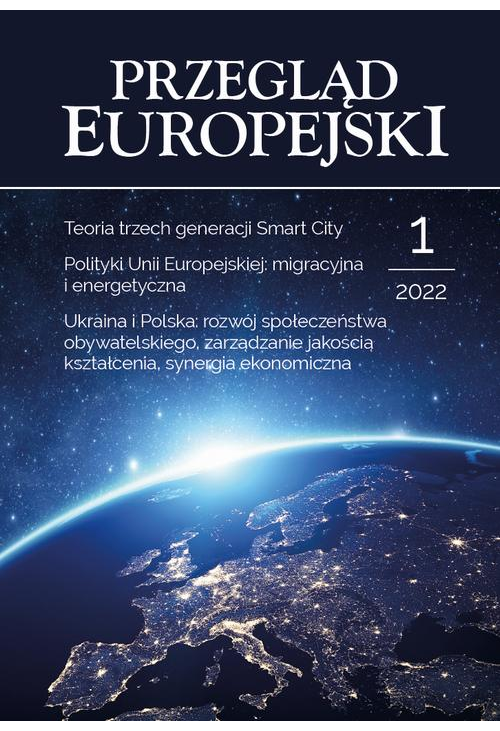
ebook Przegląd Europejski 1/2022
Rok wydania:
2022
Zawartość numeru koncentruje się wokół trzech grup tematów:
- teorii trzech generacji Smart City,
- polityki migracyjnej i energetycznej Unii Europejskiej,
- rozwoju społeczeństwa obywatelskiego, zarządzania jakością kształcenia, synergii ekonomicznej w Ukrainie i w Polsce.
Pierwszy temat został podjęty w artykule teoretycznym, w którym autorki analizują koncepcję Smart City z wykorzystaniem teorii trzech generacji rozwoju „inteligentnych miast”. Wiedza o merytorycznych zmianach w rozumieniu składowej „smart” w koncepcji Smart City jest bardzo ważna dla administracji, polityków i władz miast, które chcą być smart, a także dla badaczy przy ocenie postępów i opracowaniu rekomendacji dla takich miast.
W ramach drugiego tematu została przedstawiona m.in. analiza ewolucji polityki energetycznej UE i trwającej transformacji energetycznej uwzględniająca strategię Europejskiego Zielonego Ładu, który wpływa na stosunki energetyczne UE z krajami trzecimi. Jako przykład wybrano Azerbejdżan – ważnego dostawcę gazu ziemnego do UE. W innym artykule zaprezentowano wyniki badania jakościowego mającego na celu analizę i prognozowanie przyszłości relacji Unii Europejskiej z państwami-eksporterami węglowodorów w Azji Środkowej, oparte na porozumieniach bilateralnych – Umowy o Partnerstwie i Współpracy.
Wśród artykułów podejmujących ostatni temat numeru znajduje się analiza struktury, funkcji i metod zarządzania jakością kształcenia we współczesnej szkole oraz propozycja systemu zarządzania szkołą na bazie tradycji. Praca została oparta na wynikach badań przeprowadzonych w szkołach Polski i Ukrainy. W innym artykule autorzy opisali rolę organizacji pozarządowych (NGOs) oraz ocenili ich zdolności do działania w krytycznych okolicznościach, takich jak transformacja państwa. Badanie kładzie szczególny nacisk na rolę organizacji społeczeństwa obywatelskiego w dyskursie politycznym i medialnym w Gruzji i w Ukrainie, wzbogacając naukę o nowy materiał empiryczny, związany z zaangażowaniem takich organizacji w procesy legislacyjne oraz w rozwój państwa.
*********
The content of the issue focuses on three groups of topics:
- the theory of the three generations of the Smart City,
- the migration and energy policy of the European Union,
- the development of civil society, quality management of education, and economic synergy in Ukraine and Poland.
The first topic is addressed in a theoretical article in which the authors analyse the Smart City concept using the theory of three generations of \'smart city\' development. Knowledge of substantive changes in understanding the \'smart\' component of the Smart City concept is essential for administrations, politicians and city authorities that want to be smart, as well as for researchers when assessing progress and developing recommendations for such cities.
The second topic covers, among other things, an analysis of the evolution of EU energy policy and the ongoing energy transition regarding the European Green Deal strategy, which affects the EU\'s energy relations with third countries. Azerbaijan, a significant supplier of natural gas to the EU, was chosen as an example. Another article presents the results of a qualitative study to analyse and forecast the future of the European Union\'s relations with hydrocarbon exporting countries in Central Asia, based on bilateral agreements - the Partnership and Cooperation Agreements.
Among the articles addressing the final topic of the issue is an analysis of the structure, functions and methods of educational quality management in a contemporary school and a proposal for a school management system based on tradition. The contribution is based on research conducted in Polish and Ukrainian schools. In one article, the authors described the role of non-governmental organisations (NGOs) and assessed their capacity to act in critical circumstances such as state transition. The study places particular emphasis on the role of civil society institutions in political and media discourse in Georgia and Ukraine, enriching the study with new empirical material related to the involvement of such institutions in legislative processes and state development.
- teorii trzech generacji Smart City,
- polityki migracyjnej i energetycznej Unii Europejskiej,
- rozwoju społeczeństwa obywatelskiego, zarządzania jakością kształcenia, synergii ekonomicznej w Ukrainie i w Polsce.
Pierwszy temat został podjęty w artykule teoretycznym, w którym autorki analizują koncepcję Smart City z wykorzystaniem teorii trzech generacji rozwoju „inteligentnych miast”. Wiedza o merytorycznych zmianach w rozumieniu składowej „smart” w koncepcji Smart City jest bardzo ważna dla administracji, polityków i władz miast, które chcą być smart, a także dla badaczy przy ocenie postępów i opracowaniu rekomendacji dla takich miast.
W ramach drugiego tematu została przedstawiona m.in. analiza ewolucji polityki energetycznej UE i trwającej transformacji energetycznej uwzględniająca strategię Europejskiego Zielonego Ładu, który wpływa na stosunki energetyczne UE z krajami trzecimi. Jako przykład wybrano Azerbejdżan – ważnego dostawcę gazu ziemnego do UE. W innym artykule zaprezentowano wyniki badania jakościowego mającego na celu analizę i prognozowanie przyszłości relacji Unii Europejskiej z państwami-eksporterami węglowodorów w Azji Środkowej, oparte na porozumieniach bilateralnych – Umowy o Partnerstwie i Współpracy.
Wśród artykułów podejmujących ostatni temat numeru znajduje się analiza struktury, funkcji i metod zarządzania jakością kształcenia we współczesnej szkole oraz propozycja systemu zarządzania szkołą na bazie tradycji. Praca została oparta na wynikach badań przeprowadzonych w szkołach Polski i Ukrainy. W innym artykule autorzy opisali rolę organizacji pozarządowych (NGOs) oraz ocenili ich zdolności do działania w krytycznych okolicznościach, takich jak transformacja państwa. Badanie kładzie szczególny nacisk na rolę organizacji społeczeństwa obywatelskiego w dyskursie politycznym i medialnym w Gruzji i w Ukrainie, wzbogacając naukę o nowy materiał empiryczny, związany z zaangażowaniem takich organizacji w procesy legislacyjne oraz w rozwój państwa.
*********
The content of the issue focuses on three groups of topics:
- the theory of the three generations of the Smart City,
- the migration and energy policy of the European Union,
- the development of civil society, quality management of education, and economic synergy in Ukraine and Poland.
The first topic is addressed in a theoretical article in which the authors analyse the Smart City concept using the theory of three generations of \'smart city\' development. Knowledge of substantive changes in understanding the \'smart\' component of the Smart City concept is essential for administrations, politicians and city authorities that want to be smart, as well as for researchers when assessing progress and developing recommendations for such cities.
The second topic covers, among other things, an analysis of the evolution of EU energy policy and the ongoing energy transition regarding the European Green Deal strategy, which affects the EU\'s energy relations with third countries. Azerbaijan, a significant supplier of natural gas to the EU, was chosen as an example. Another article presents the results of a qualitative study to analyse and forecast the future of the European Union\'s relations with hydrocarbon exporting countries in Central Asia, based on bilateral agreements - the Partnership and Cooperation Agreements.
Among the articles addressing the final topic of the issue is an analysis of the structure, functions and methods of educational quality management in a contemporary school and a proposal for a school management system based on tradition. The contribution is based on research conducted in Polish and Ukrainian schools. In one article, the authors described the role of non-governmental organisations (NGOs) and assessed their capacity to act in critical circumstances such as state transition. The study places particular emphasis on the role of civil society institutions in political and media discourse in Georgia and Ukraine, enriching the study with new empirical material related to the involvement of such institutions in legislative processes and state development.
Spis treści ebooka Przegląd Europejski 1/2022
TEORIA I METODOLOGIA STUDIÓW EUROPEJSKICHKarolina KOVIAZINA, Svetlana KUCHERIAVAIA • Co znaczy bycie smart dla europejskiego miasta? Teoria trzech generacji rozwoju Smart City 11
Olena HRYBIUK • Jakość jako strategia zarządzania szkołą i placówką oświatową 29
Serhii KASIAN • Integracja europejska, komunikacja marketingowa i logistyka wirtualna w ukraińskich i polskich przedsiębiorstwach 51
PRAWO, INSTYTUCJE I POLITYKI UNII EUROPEJSKIEJ
Vladyslav BUTENKO • Zewnętrzna polityka energetyczna UE: przypadek Azerbejdżanu 61
Tomasz CHRULSKI • Opracowanie prognoz średnioterminowych zapotrzebowania na gaz ziemny dla obszaru Unii Europejskiej 73
Erwin METERA • Umowy o Partnerstwie i Współpracy a bezpieczeństwo energetyczne Unii Europejskiej w kontekście Azji Środkowej 87
Tigran OHANYAN, Marta NAYCHUK-KHRUSHCH, Hovhannes HARUTYUNYAN • Polityka migracyjna Unii Europejskiej i wyzwania ostatnich lat 101
HISTORIA, KULTURA I SPOŁECZEŃSTWO W EUROPIE
Iryna KOSTETSKA • Znaczenie funkcjonowania rolniczych grup producenckich w rozwoju obszarów wiejskich Ukrainy 119
Diana MYKHAILOVA-KACIMI • Geopolityczna rywalizacja światowych mocarstw w czasie pandemii COVID-19 133
Harutyun VOSKANYAN • Armenia w trójkącie zarządzania mocarstw: regionalna rywalizacja na tle konfliktu w Górskim Karabachu 145
Arsen YATSENKO, Irina TKESHELASHVILI, Ihor HURAK • Rozwój organizacji pozarządowych w Ukrainie i w Gruzji: wymiar społeczny i polityczny 161
IMPRESJE EUROPEJSKIE
Jaroslav DVORAK • Recenzja książki: Tobias Haimin Wung-Sung (2019), Beyond the Border. Young Minorities in the Danish–German Borderlands, 1955-1971, Berghahn Books, New York – Oxford, 270 pages 179
*********
THEORIES AND METHODS IN EUROPEAN STUDIES
Karolina KOVIAZINA, Svetlana KUCHERIAVAIA • What does it mean smart for European city? The theory of three generations of Smart City 11
Olena HRYBIUK • Quality as a management strategy for a school and educational institution 29
Serhii KASIAN • Eurointegration, marketing communication and virtual logistic of Ukrainian and Polish enterprises 51
EU LAW, INSTITUTIONS AND POLICIES
Vladyslav BUTENKO • EU external energy policy: the case of Azerbaijan 61
Tomasz CHRULSKI • Forecasting medium-term natural gas demand for the European Union 73
Erwin METERA • Partnership and Cooperation Agreements and the European Union\'s energy security in the context of Central Asia 87
Tigran OHANYAN, Marta NAYCHUK-KHRUSHCH, Hovhannes HARUTYUNYAN • Migration policy of the European Union and challenges in last years 101
HISTORY, CULTURE AND SOCIETY IN EUROPE
Iryna KOSTETSKA • The importance of the functioning of agricultural producer\'s groups for ensuring the development of rural areas in Ukraine 119
Diana MYKHAILOVA-KACIMI • Geopolitical competition of global powers during the COVID-19 pandemic 133
Harutyun VOSKANYAN • Armenia in a Triangle of Great Power Management: Regional competition on the Nagorno-Karabakh conflict 145
Arsen YATSENKO, Irina TKESHELASHVILI, Ihor HURAK • NGOs’ development in Ukraine and Georgia: social and political dimensions 161
EUROPEAN IMPRESSIONS
Jaroslav DVORAK • Book review: Tobias Haimin Wung-Sung (2019), Beyond the Border. Young Minorities in the Danish–German Borderlands, 1955-1971, Berghahn Books, New York – Oxford, 270 pages 179
Szczegóły ebooka Przegląd Europejski 1/2022
- Wydawca:
- Wydawnictwa Uniwersytetu Warszawskiego
- Rok wydania:
- 2022
- Typ publikacji:
- Ebook
- Język:
- polski
- Format:
- Redakcja:
- Marta Witkowska
- Liczba stron:
- 182
- Miejsce wydania:
- Warszawa
Recenzje ebooka Przegląd Europejski 1/2022
-
Reviews (0)

Na jakich urządzeniach mogę czytać ebooki?
 Na czytnikach Kindle, PocketBook, Kobo i innych
 Na komputerach stacjonarnych i laptopach
 Na telefonach z systemem ANDROID lub iOS
 Na wszystkich urządzeniach obsługujących format plików PDF, Mobi, EPub
- Za darmo
0,00 zł



@CUSTOMER_NAME@
@COMMENT_TITLE@
@COMMENT_COMMENT@