

Najpopularniejsze kategorie
Pozostałe kategorie
Najpopularniejsi autorzy
Bestseller


- Za darmo
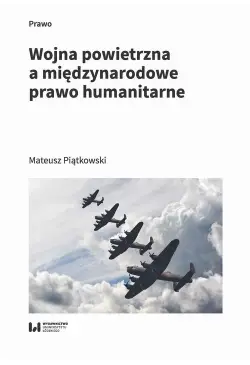
ebook Air Warfare and International Humanitarian Law
Wydawca:
Wydawnictwo Uniwersytetu Łódzkiego
Rok wydania:
2025
Military aviation is a one of most crucial elements of the warfare, both past and present. Vet, the legal ramifications of the air warfare are scattered due to the lack of a treaty comprehensively regulating the conduct of aerial operations during the armed conflicts. This monograph aims to present the history of air warfare, and the corresponding development of the law of air warfare, from the beginnings of the military aviation to the era of unmanned and autonomous aircrafts.
This book is a translation into English of the monography Wojna powietrzna a międzynarodowe prawo humanitarne {Wydawnictwo Uniwerystetu Łódzkiego, Łódź 2021). Project was financed by state budget funds from the Ministry of Education and Science (Poland) under the program “Doskonała nauka II. Wsparcie monografii naukowych”, number MONOG/SP/0055/2023/01. The book was updated by the relevant observation arising out of the armed conflicts ongoing in the Ukraine and the Middle East.
This book is a translation into English of the monography Wojna powietrzna a międzynarodowe prawo humanitarne {Wydawnictwo Uniwerystetu Łódzkiego, Łódź 2021). Project was financed by state budget funds from the Ministry of Education and Science (Poland) under the program “Doskonała nauka II. Wsparcie monografii naukowych”, number MONOG/SP/0055/2023/01. The book was updated by the relevant observation arising out of the armed conflicts ongoing in the Ukraine and the Middle East.
Spis treści ebooka Air Warfare and International Humanitarian Law
Introduction 15Selection of the main subject of the monograph 17
Structure of the study 20
Objectives and main theses of the study 22
Research methodology 23
Chapter I
The phenomenon of air warfare from the beginnings of military aviation to the present day 25
1. Definition of air warfare 25
2. Air warfare from a historical perspective 29
2.1. The birth of military aviation and its development until 1903 29
2.2. Airships and first strategic bombings 30
2.3. Development of military aviation on the eve of World War I 32
2.4. The course of the hostilities during World War I (1914–1918) 33
2.5. The use of aviation in World War I – conclusions 37
3. The doctrine of air warfare in the inter-war period 38
3.1. Giulio Douhet’s concept 38
3.2. Amadeus Mecozzi’s concept 42
3.3. “Winged Defense” by William “Billy” Mitchell. American strategic bombing theory 42
3.4. Hugh Trenchard. The British concept of conducting aerial warfare 45
3.5. The doctrine of air necessity by James M. Spaight 48
3.6. Polish perception of the concept of aviation deployment in the interwar period 49
4. Aviation in the interwar period 52
4.1. Air policing 52
4.2. Air warfare during the interwar period 53
5. An overview of the operations of air forces during World War 53
5.1. Initial period 53
5.2. The development of the concept of “morale” bombing 55
5.3. The beginning of carpet bombing. Arrival of US forces in Europe 59
5.4. Controversial effects of the Combined Bomber Offensive 62
5.5. Conclusions regarding the air warfare strategy during 1939–1945 in the European theater of World War II 64
5.6. The Pacific theater of war 1939–1945 65
6. Post-war use of air force 68
6.1. Korea – a forgotten war 68
6.2. The Six-Day War and aerial clashes during the Yom Kippur conflict 72
7. Armed conflict in Vietnam – a new perspective on the use of air force 73
7.1. Operation “Rolling Thunder” 73
7.2. Operations “Linebacker I” and “Linebacker II” and precision-oriented air warfare 77
7.3. Rules of Engagement (ROE) and targeting 84
8. Contemporary Air Warfare 85
8.1. Air clashes in the Iraq-Iran war during the period of 1980–1988 85
8.2. Falkland Islands 1982 as an example of a limited conflict 86
8.3. Iraq 1991 and air dominance 87
8.4. Iraq no-fly zones 91
8.5. The civil war in the former Yugoslavia and no-fly zone 92
8.6. Serbia 1999 – confirmation of the Douhet doctrine? 94
8.7. Iraq 2003 and selective elimination 96
8.8. Libya 2011 98
8.9. Ukraine 2014 99
9. Aviation in the War on Terror 100
9.1. Use of unmanned military aircraft 100
9.2. Air operation in Afghanistan 2001 102
9.3. Syria 2011–2018 103
9.4. Aviation in operations against the so-called Islamic State 105
9.5. Ukraine 2022 107
9.6. Gaza Strip 2023 – Operation “Iron Swords” 110
9.7. The “Twelve Days-War” 111
9.8. Between Ukraine and Gaza: Robert A. Pape’s air power coercion strategies 112
10. Conclusions 112
Chapter II
The laws of air warfare and their sources 117
1. Preliminary remarks 117
2. Definition of the law of air warfare 117
3. Definition of a military aircraft 118
4. Generations of the law of air warfare 119
5. Sources of the law of air warfare 121
5.1. Preliminary remarks 121
5.2. The Martens Clause as a source of the law of air warfare 124
5.3. Intertemporal rule 128
5.4. Treaties and means of interpretation 130
5.5. Customary international law 135
5.6. General principles recognized by civilized states 143
5.7. International jurisprudence 146
5.8. Draft international treaties 147
5.9. Unilateral declarations of states 147
5.10. The position of international organizations 148
5.11. The position of quasi-judicial bodies 148
5.12. Military Commands 152
5.13. The stance of the doctrine, organizations associating experts, academic initiatives 152
6. International standards for the protection of human rights as a source of the rules of air warfare 155
Chapter III
Material scope of the law of air warfare 167
1. Preliminary remarks 167
2. War as an institution of international law 167
3. A historical look at the definition of war 168
4. From “war” to “armed conflict” 171
5. Air raid and its role in defining the boundaries of the temporal applicability of international humanitarian law 175
6. Examples of unilateral armed incidents involving aviation 176
6.1. Shooting down U2 on May 1, 1960 176
6.2. Indian intervention in Bangladesh 177
6.3. Libya 1981–1989 177
6.4. Lebanon 1984 178
6.5. Persian Gulf 1987 179
6.6. Kashmir Conflict of 1999 179
6.7. Operation “Orchard” 179
6.8. Interstate incidents during the conflict in Syria 180
6.9. Air duel between India and Pakistan in 2019 181
7. Subjective theory of armed conflict 181
8. Objective theory of armed conflict Controversies related to the moment of its establishment and the criterion of intensity 184
9. Subjective and objective elements of an armed conflict 189
9.1. Case of Robert O. Goodman and the application of international humanitarian law outside of armed conflict 193
10. Conclusions 198
11. Temporal scope of international humanitarian law 199
11.1. Historical overview 199
11.2. Returning to the declaration of war. The 1905 Russo-Japanese War 203
11.3. Third Hague Convention of 1907 207
11.4. The crime of an unannounced air attack? 208
12. Non-International Air Warfare 209
13. Non-international armed conflict 210
14. The status of the crew of a military aircraft in a non-international armed conflict 214
15. Geographical scope of application of the law of air warfare 217
Chapter IV
Development of the law of air warfare 223
1. The law of air warfare as part of the so-called Hague law. Preliminary remarks 223
2. Otto von Bismarck’s dispatch of November 18, 1870 227
3. The law of artillery bombardment 229
4. The Brussels Conference of 1874 233
5. The Laws of War on Land drafted by the Institute of International Law 236
6. An attempt to delegalize air warfare – The Hague 1899 237
7. The Draft of the Institute of International Law on Bombardment of Open Towns by Naval Forces 1896 240
8. Land-based and naval bombardment – The Hague 1899 241
9. Legal status of airspace at the beginning of the 20th century 244
10. The first draft by Paul Fauchille from 1902 245
11. The International Law of Air Warfare drafted by Paul Fauchille in 1902 249
12. The Session of the Institute of International Law in Ghent in 1906 252
13. The development of aviation law before World War I 254
14. Development of the principle of exclusive state sovereignty in airspace 257
15. The Second Hague Peace Conference of 1907 258
15.1. General remarks 258
15.2. Extension of the IV Declaration of 1899 on the prohibition of the discharge of projectiles or other explosives from balloons 259
15.3. The Adoption of Article 25 of the Hague Regulations of 1907 261
15.4. Fiasco of XIV Hague Declaration of 1907 264
15.5. Naval Bombardments at the Hague Conference of 1907 265
15.6. Den Beer Poortugael’s interpretative declaration 266
15.7. Discussion of the list of military objectives in the Ninth Hague Convention of 1907 268
15.8. The differences between the rules governing land and naval bombardment 269
16. Session of the Institute of International Law in 1910 270
17. Session of the Institute of International Law in 1911 272
18. Paul Fauchille’s draft law of air warfare 273
19. Commentary to the draft of air warfare code of 1911 277
20. Le Moyne’s draft law of air warfare 278
21. A draft law of air warfare by James M. Spaight 280
22. Regulation of the legal status of airspace in the years 1911–1918 284
22.1. The British Aerial Navigation Act of 1911 284
22.2. The Franco-German Agreement of 1913 284
22.3. World War I and the attitude of neutral states 285
23. Erosion of the immunity of undefended cities 288
24. Criticism of Article 25 of the Hague Regulations of 1907. Discussion of the legal status of London as a defended city 288
25. World War I – French doctrine and air bombing 291
26. Article 25 of the Hague Regulations of 1907 and its significance in air warfare 294
27. Paul Fauchille’s Air Bombing initiative 295
28. Attack on Liepāja, January 29, 1915 298
29. A casuist approach to the theory of military objective 298
Chapter V
The Hague Rules of Air Warfare and their impact on the law of air warfare during World War II – the state of the law of air warfare in the years 1945–1972 301
1. Experiences of World War I – air warfare from a legal perspective. Status of the Fourteenth Hague Declaration of 1907 301
2. The Washington Conference on the Limitation of Armaments 1921–1922 303
3. Air warfare at the Washington Conference on the Limitation of Armaments 305
4. 1923 Hague Rules of Air Warfare 306
4.1. General remarks 306
4.2. The proceedings of the commission of jurists 307
4.3. The Italian and American proposals to regulate air bombing 309
4.4. Status of military aircraft and crew in the light of the 1923 rules 311
5. The law of air bombing in the 1923 regulation 320
5.1. General remarks 320
5.2. Terrorist bombings 320
5.3. The criterion of a defended area and the criterion of a military target 321
5.4. Impracticability of the undefended area test in the context of air warfare 322
5.5. Consequence of recognizing a given area as defended 324
5.6. Ninth Hague Convention on Naval Bombardment vs. air operations 325
5.7. Definition of a military target in the light of Article 24 of the 1923 Hague Rules of Air Warfare 327
5.8. Division into tactical and strategic bombing 329
6. Flaws of the 1923 Hague Rules of Air Warfare 330
7. Reception of the 1923 Hague Rules of Air Warfare in the International Law Doctrine 334
8. The Doctrine of International Law and the Theory of Military Objective 341
9. Other issues addressed under the 1923 Hague Rules of Air Warfare 344
9.1. Protection of cultural assets 344
9.2. Espionage in air warfare 345
9.3. Authority over enemy and neutral aircraft as well as persons on board 345
9.4. Cases of shooting down civil aircraft belonging to belligerents during World War II 346
9.5. Final provisions of the 1923 Hague Rules of Air Warfare 348
10. Report of ICRC experts from 1930 350
11. Prague Congress of 1922. Air warfare and international aviation law 353
12. World Disarmament Conference of 1932–1934 in Geneva 354
13. International Law Association (ILA) 362
13.1. The ILA air warfare draft from Buenos Aires, 1922 362
13.2. Stockholm Conference of 1924 363
13.3. Draft of Air Bombing Convention – Amsterdam 1938 365
14. ICRC Draft Convention of 1934 368
15. The League of Nations and the issue of air warfare 370
16. Resolution of the League of Nations of 1938 on aerial bombardment (Protection of Civilian Populations against Bombing from the Air in Case of War) 373
16.1. General remarks. The so-called Third Reich peace plan 373
16.2. Air warfare in China and the League of Nations 374
16.3. Speech by Neville Chamberlain in the House of Commons on June 21, 1938 375
16.4. Discussion within the Council of the League of Nations 375
16.5. Resolution of the Assembly of the League of Nations of 30 September 1938 379
16.6. International Fact-Finding Commission on Air bombing in Spain 381
17. Study by A. Henry-Coüannier 382
18. Attempts to ratify the 1923 Document 384
18.1. Analysis of diplomatic correspondence 387
19. Examples of the implementation of the 1923 Hague Rules of Air Warfare into military regulations 389
19.1. Italy 389
19.2. Japan 391
19.3. The United Kingdom 391
19.4. The Republic of Poland 392
19.5. Third Reich 394
19.6. France 395
19.7. The United States of America 395
20. Did the 1923 Hague Rules of Air Warfare obtain customary status before September 1, 1939? 397
21. World War II and the state of compliance with the norms of the law of air war 401
21.1. President Roosevelt’s declaration of September 1, 1939 401
21.2. The only undefended city? Wieluń, 1 September 1939 403
21.3. Erosion of opinio iuris and the beginning of total air warfare 405
21.4. Affirmation of unlimited air warfare 407
22. Reprisals in air warfare as a justification for total air war 410
23. Status of the Law of Air Warfare in the Initial Period of World War II 415
24. The collapse of the norms governing air warfare during World War II 418
24.1. Desuetude 418
24.2. Non liquet 419
24.3. A raid of 1000 bombers against Kiel – the applicability of the 1923 Hague Rules of Air Warfare comes to an end? 421
25. ICRC during World War II 424
26. ICRC New Delhi Draft of 1956 425
26.1. General remarks 425
26.2. Military objectives in the light of the ICRC draft of 1956 425
26.3. Definition of the term “attack” 427
26.4. Development of the American Vision of the Law of Air Warfare in 1956–1976 429
27. The Doctrine of International Law in Relation to the Phenomenon of Unlimited Air War 431
Chapter VI
Air warfare law in light of AP I 437
1. General Remarks 437
2. Definition of the concept of civilian population. The issue of quasi-combatants 439
3. Area bombing in AP I 445
4. Prohibition of indiscriminate attacks in AP I 450
4.1. Means of attack 450
4.2. Methods of attack 453
4.3. Types of air bombing 455
4.4. Critical point of the law of air bombing 458
5. Rule of proportionality in AP I 459
5.1. General remarks 459
5.2. Subjectivism of the rule of proportionality in AP I 463
5.3. Application of the rule of proportionality in practice 466
5.4. The rule of proportionality – interpretative guidelines 469
5.5. Protection of a military aircraft crew as an element of the rule of proportionality 471
5.6. Illegal methods of conducting warfare as part of the proportionality equation 472
6. Definition of attack 474
7. Interpretative declarations to the content of AP I 477
8. Definition of military objectives in AP I 478
8.1. General remarks. “Military target” or “military object”? 478
8.2. The course of preparatory works 481
8.3. Article 52 of AP I as the focal point of the principle of distinction 485
8.4. Classification of military objectives in the light of AP I 486
8.5. Dual-use objects in the light of Article 52 of AP I 489
8.6. Abstract nature of the definition of military target in AP I 494
8.7. Significant contribution to military activity 495
8.7.1. The problem of the attack on the An-225 496
8.8. Definite military advantage 497
8.9. AP I and the principle of military energy conservation 498
8.10. Extending the concept of a military objective in The United States’s military doctrine 500
8.11. Presumption of the civilian intended use of certain objects 503
9. Protection of cultural assets 504
10. Environmental protection and the law of air warfare 508
11. Protection of special type infrastructure 511
12. Precautions 516
12.1. General remarks 516
12.2. Preparatory work on the content of the precautionary principle 517
12.3. Interpretation of Article 57 of AP I 520
13. The status of non-defended areas 528
14. The Fourth Geneva Convention of 1949 and the Law of Air War 536
15. The Third Geneva Convention of 1949 and the Law of Air War 538
16. The Second Geneva Convention of 1949 542
17. Relation of AP I to earlier norms of air bombardment law 542
18. Limits of codification of the law of air warfare by AP I 546
Chapter VII
Selected detailed aspects of the law of air warfare 551
1. Preliminary comments 551
2. Status of persons evacuating from a damaged aircraft in an emergency 551
3. Perfidy, use of false markings 558
4. Perfidy vs. ruses 564
5. Camouflage in air warfare 568
6. Markings of military aircraft 574
7. Markings with reduced visibility. Markings of unmanned aerial vehicles 581
8. The obligation of wearing military uniforms by the crew of a military aircraft 585
9. Rules governing the legality of military aircraft armament 588
9.1. Prohibition of causing superfluous injury or unnecessary suffering 588
9.2. Obligation to carry out a legal review of weapons 597
10. Selected issues related to the use of aircraft armament 599
10.1. Precision-guided munitions 599
10.2. Incendiary munitions under 400 grams 606
10.3. Incendiary bombs 608
10.4. White phosphorus 615
10.5. The use of bombs of significant weight in urban conditions 616
11. Air warfare under international aviation law 617
11.1. Paris Convention of 1919 617
11.2. 1944 Chicago Convention (Convention on International Civil Aviation) 619
11.3. Civilian aircraft in an armed conflict zone 619
Chapter VIII
Neutrality in air warfare 623
1. Neutrality in air warfare 623
2. Neutrality in the context of air operations during World War II: the internment of flight crews and equipment 625
3. Deliveries of aviation equipment and practice of neutral/non-participating states 629
4. Neutrality after the adoption of the Charter of the United Nations 630
5. Neutrality and being a party to an armed conflict 636
Chapter IX
Air warfare and international jurisprudence 639
1. Preliminary comments 639
2. The case of Lieutenants Walker and Smith – the use of incendiary ammunition in air warfare 639
3. Judgement of the Greco-German Mixed Arbitral Tribunal in the Coenca Brothers v. Germany case and the judgement of the Romanian-German Mixed Arbitral Tribunal in Kiriadolou v. Germany 640
4. The Lotus case and its impact on international humanitarian law 643
5. Aerial bombardment during the Spanish Civil War 645
6. Kommandobefehl 645
7. The Essen Lynching case 646
8. Enemy Airmen’s Act 647
9. The sinking of the ship “Laconia” 649
10. The International Military Tribunal at Nuremberg 652
10.1. Luftwaffe commanders before the International Military Tribunal (IMT) 652
10.2. The Einsatzgruppen Trial 657
10.3. The Erhard Milch Trial 660
11. The International Military Tribunal for the Far East 660
12. Rendulic rule 664
13. Ryuichi Shimoda et al. v. The State 667
14. Advisory opinion of the ICJ of 1996 671
15. International Criminal Tribunal for the Former Yugoslavia 677
15.1. Stanislav Galić – attacking the civilian population, judicial application of the rule of proportionality, customary status of the 1923 Hague Rules of Air Warfare 677
15.2. Kupreškić and feigned bombing of military objectives 681
15.3. Milan Martić – the use of cluster munitions in a populated area 683
15.4. Dragomir Milošević – fuel-air bombs, TV station as a military target 686
15.5. Slobodan Praljak and classification of bridges as military objectives 688
15.6. Gotovina – unjustified destruction of the village and indiscriminate bombing 690
16. Report of the Committee to the ICTY Prosecutor on the NATO Bombing Campaign in Serbia in 1999 695
17. The Goldstone Report 705
18. Libya 2011 708
19. Operation “Protective Edge” 709
20. Eritrea-Ethiopia Claims Commission 713
21. The case of Col. Georg Klein 714
22. Independent International Commission of Inquiry on the Syrian Arab Republic 716
23. Report to the United States Congress on the course of action during the First Gulf War 717
24. The OSCE expert report under the so-called Moscow Mechanism concerning the course of military operations in Ukraine 719
25. Gaza 2023–2024 721
Chapter X
Unmanned operations and autonomy in air warfare 723
1. Unmanned operations in air warfare 723
1.1. General Remarks 723
1.2. Unmanned operation and the Law of Air Warfare 727
1.3. Status of Civilian Operators of Unmanned Military Aircraft 730
2. Autonomy and future aerial warfare 731
2.1. Preliminary comments 731
2.2. Definition of autonomous operation 734
2.3. Ideal autonomy of operation in aerial warfare 735
2.4. The legality of lethal autonomy 738
2.5. Surrender to an autonomous unmanned military aircraft 744
2.6. Treaty solution regarding LAWS 746
2.7. “Meaningful human control” 751
2.8. The state of discussions on LAWS after 2019. The issue of loitering munitions 754
2.9. Lessons from the history of the law of air warfare applicable to future LAWS regulations. De lege ferenda postulates 755
Conclusion 759
References 765
Abbreviations 847
Szczegóły ebooka Air Warfare and International Humanitarian Law
- ISBN:
- 9788383317489
- Wydawca:
- Wydawnictwo Uniwersytetu Łódzkiego
- Rok wydania:
- 2025
- Typ publikacji:
- Ebook
- Język:
- polski
- Format:
- Liczba stron:
- 850
Recenzje ebooka Air Warfare and International Humanitarian Law
-
Reviews (0)

Na jakich urządzeniach mogę czytać ebooki?
 Na czytnikach Kindle, PocketBook, Kobo i innych
 Na komputerach stacjonarnych i laptopach
 Na telefonach z systemem ANDROID lub iOS
 Na wszystkich urządzeniach obsługujących format plików PDF, Mobi, EPub
- Za darmo
0,00 zł









@CUSTOMER_NAME@
@COMMENT_TITLE@
@COMMENT_COMMENT@