
Najpopularniejsze kategorie
Pozostałe kategorie
Najpopularniejsi autorzy
Bestseller

- -16%
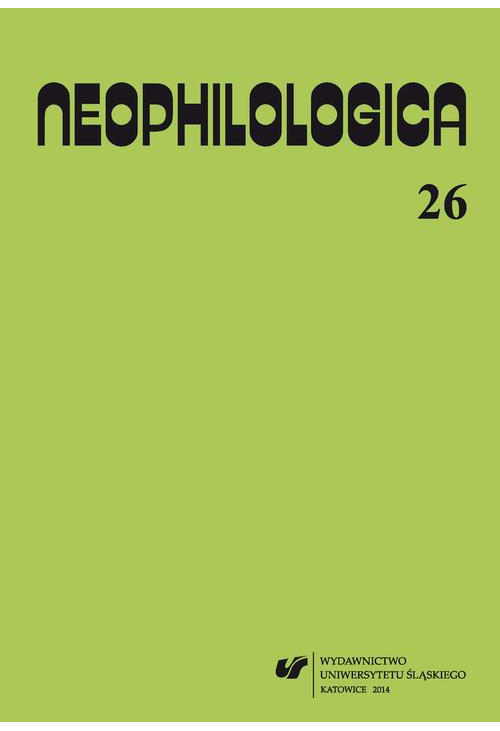
ebook Neophilologica 2014. Vol. 26: Le concept d\'événement et autres études
Wydawca:
Wydawnictwo Uniwersytetu Śląskiego
Rok wydania:
2014
Textes réunis par Laura Calabrese, Fabrice Marsac, Dan Van Raemdonck.
Tom 26 Neophilologica jest zbiorem 21 artykułów autorstwa w większości uczonych zagranicznych. Tematami przewodnimi numeru są, w pierwszej części, analizy pojęcia zdarzenia omawianego z różnych punktów widzenia, w drugiej części zaś, zagadnienia klas obiektowych, opis języka zorientowany obiektowo dla celów automatycznego tłumaczenia tekstów i kwestie pokrewne omawiane i rozwijane pod wpływem prac W. Banysia i G. Grossa. Zdecydowana większość tekstów została zredagowana w języku francuskim, 2 artykuły zostały napisane w języku włoskim i 1 w języku hiszpańskim. Wszystkie teksty zawierają abstrakty oraz słowa klucze w języku angielskim.
Tom 26 Neophilologica jest zbiorem 21 artykułów autorstwa w większości uczonych zagranicznych. Tematami przewodnimi numeru są, w pierwszej części, analizy pojęcia zdarzenia omawianego z różnych punktów widzenia, w drugiej części zaś, zagadnienia klas obiektowych, opis języka zorientowany obiektowo dla celów automatycznego tłumaczenia tekstów i kwestie pokrewne omawiane i rozwijane pod wpływem prac W. Banysia i G. Grossa. Zdecydowana większość tekstów została zredagowana w języku francuskim, 2 artykuły zostały napisane w języku włoskim i 1 w języku hiszpańskim. Wszystkie teksty zawierają abstrakty oraz słowa klucze w języku angielskim.
Spis treści ebooka Neophilologica 2014. Vol. 26: Le concept d\'événement et autres études
ContentsJean-Pierre DESCLÉS: Event as a cognitive concept / 7
Katarzyna KWAPISZ-OSADNIK: The event as an effect of the conceptualization of a situation. A few observations pertaining to the relation between the grammatical, semantic, syntactic-discourse aspects and the way of conceptualizing the situation / 23
Elżbieta BIARDZKA: Enunciative event put into speech: three different approaches / 36
Ewa PILECKA: être (le) témoin de, a dedicated predicate which selects event nouns? / 49
Jadwiga COOK: To see, hear and feel an event — on Polish translation of French structures with verbs of perception / 63
Marion BECHET, Fabrice HIRSCH, Fabrice MARSAC, Rudolph SOCK: The primary socialist
Elections: an event at the origin of a new speaking style? / 78
Catherine COLLIN: Hendiadys and construction of an event in contemporary English / 90
Charlotte DANINO: A linguistic analysis of a discourse on an ongoing event: the case of 9/11 / 106
Christian SURCOUF: “Soap verbs”: why do achievements such as “Il se casse la jambe” sound odd with the present tense? / 122
Clair-Antoine VEYRIER: Invitation as co-construction and emergence of an event / 140
Laura CALA BRESE, Audrey ROIG, Dan Van RAEMDONCK: A morphosyntactic analysis
of event names in newspaper headlines / 154
Lucie BARQUE, Pauline HAAS, Richard HUYGHE: The event / object nominal polysemy:
which objects for which events? / 170
Lucie STEIBLÉ, Rudolph SOCK: Pretzel and Bretzel: an event approach to and event analysis
of speech signals for the study of Alsatian plosives / 188
Myriam BOULIN: Describing motion events in French, English and Mandarin Chinese: what
is the deictic center? / 201
Silvia ADLER: Fortuitous events through the prism of general nouns / 217
Anna CZEKAJ: How should the notion of the object class be understood? / 232
Agnieszka PALION-MUSIOŁ, Aleksandra ŻŁOBIŃSKA-NOWAK: A syntactic-semantic analysis of the Spanish verb ganar in the framework of the object oriented approach / 245
Beata ŚMIGIELSKA: Some theoretical and practical remarks about the translation from French into Polish based on the object oriented approach / 264
Sonia SZRAMEK-KARCZ: The Object Oriented Approach or EuroWordNet — which is a better engine for machine translation? Part II: hierarchy, semantic inheritance and disambiguation / 280
Aleksandra PALICZUK: Space — thought — language. The Conceptualization of città (‘city’) in Italian / 298
Claudio SALMERI: The Problem of translation of old texts as a particular issue. Archaisation / 310
Szczegóły ebooka Neophilologica 2014. Vol. 26: Le concept d\'événement et autres études
- Wydawca:
- Wydawnictwo Uniwersytetu Śląskiego
- Rok wydania:
- 2014
- Typ publikacji:
- Ebook
- Język:
- włoski
- Format:
- Redakcja:
- Wiesław Banyś
- Liczba stron:
- 324
- Miejsce wydania:
- Katowice
Recenzje ebooka Neophilologica 2014. Vol. 26: Le concept d\'événement et autres études
-
Reviews (0)

Na jakich urządzeniach mogę czytać ebooki?
 Na czytnikach Kindle, PocketBook, Kobo i innych
 Na komputerach stacjonarnych i laptopach
 Na telefonach z systemem ANDROID lub iOS
 Na wszystkich urządzeniach obsługujących format plików PDF, Mobi, EPub
- -16%
-16%
46,20 zł
38,81 zł








@CUSTOMER_NAME@
@COMMENT_TITLE@
@COMMENT_COMMENT@