
Najpopularniejsze kategorie
Pozostałe kategorie
Najpopularniejsi autorzy
Bestseller

- Za darmo
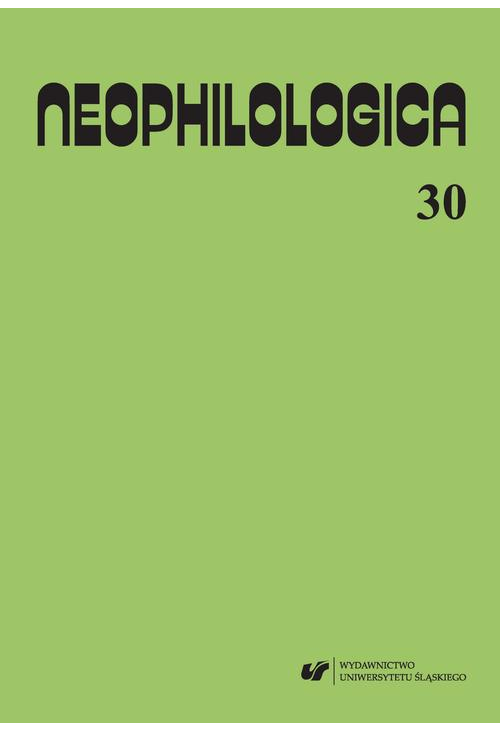
ebook Neophilologica 2018. Vol. 30: Études sémantico-syntaxiques des langues romanes
Wydawca:
Wydawnictwo Uniwersytetu Śląskiego
Rok wydania:
2018
Kolejny - 30 tom czasopisma „Neophilologica” składa się z 24 artykułów, napisanych w języku francuskim, włoskim, hiszpańskim oraz angielskim, których autorzy podejmują zagadnienia związane z różnorodną tematyką językoznawczą od badań kognitywistycznych, po inne ujęcia teoretyczne, np. odwołujące się do filozofii, epistemologii, koncepcji struktur predykatowo – argumentowych Stanisława Karolaka, Andrzeja Bogusławskiego, czy też wykorzystujące koncepcję Gastona Grossa lub Wiesława Banysia w rozważaniach na temat tłumaczenia automatycznego. W różnych ujęciach i kontekstach poruszane są także zagadnienia składniowe, leksykologiczne, semantyczne oraz związane z pragmatyką językoznawczą.
Spis treści ebooka Neophilologica 2018. Vol. 30: Études sémantico-syntaxiques des langues romanes
ContentsGaston Gross: Lexical Complexity: the substantive débat(s) / 9
Wiesław Banyś: New Old Paradigms: Object-Oriented Approach, Object Classes, Ecological Psychology and Linguistics / 25
Sonia Berbinski: Genre — between partial identification and suspensive approximation / 42
Aleksandra Chrupała: Linguistic comings and goings between the French language in France and the one in Quebec / 57
Anna Czekaj: Perception and metonymy in automatic translation / 76
Francis Grossmann, Anna Krzyżanowska: How to apologize in French and Polish: pragma-semantic study / 89
Michał Hrabia: Verb remettre and its Polish equivalents. Disambiguation and semanticprefixal analysis for the purpose of machine translation / 109
Małgorzata Izert: Nominal quantifiers of meteorological and hydrographic origin in French and Polish / 121
Anna Kieliszczyk: Readers’ discourse in the French and Polish press / 136
Monika Kostro: Between front-stage and backstage: the usage of the familiar pronouns of address in the French and Polish political media discourse / 148
Piotr Krzyżanowski: Functions of nominal vocative forms in Polish and French / 160
Katarzyna Kwapisz-Osadnik: Italian prepositions di and da and the French preposition de.A contrastive study in a cognitive framework / 169
Agnieszka Latos: Some reflections on feminine agentives: Italian and Polish in comparison / 181
Julia M. Murrmann: An introduction to the language of physiotherapy. The linguistic features of the communication in movement rehabilitation / 197
Swietłana Niewzorowa: Alternative questions / 212
Aleksandra Paliczuk: Linguistic picture of the past based on the verbal aspect in Italian, Polish and English / 229
Magdalena Perz: The meaning of a polysemous adjective in a bilingual perspective — the quest for equivalence / 243
Matthieu Pierens: The introductory verbs of feelings in French and German: a comparative diachronic study / 257
Ewa Pilecka: The expression of intensification through consequence in French and Polish: a case study (as a preliminary to its lexicographical description) / 275
Aleksandra Ritau-Barber: The metaphors of the concept musica in Italian / 287
Witold Sobczak: On the usage of “irá a + infinitive” and “iría a + infinitive” in contemporary peninsular Spanish / 305
Katarzyna Tilgner: The names of the gall / bile in Castilian language in the diachronic approach / 315
Richard Trim: The impact of morpho-syntax on contrastive metaphorisation processes in Romance and Germanic languages / 328
Grażyna Vetulani: Methods and problems of comparative linguistics research. Case study : predicate nominative in French and Polish / 340
Szczegóły ebooka Neophilologica 2018. Vol. 30: Études sémantico-syntaxiques des langues romanes
- Wydawca:
- Wydawnictwo Uniwersytetu Śląskiego
- Rok wydania:
- 2018
- Typ publikacji:
- Ebook
- Język:
- włoski
- Format:
- Redakcja:
- Monika Sułkowska
- Liczba stron:
- 352
- Miejsce wydania:
- Katowice
Recenzje ebooka Neophilologica 2018. Vol. 30: Études sémantico-syntaxiques des langues romanes
-
Reviews (0)

Na jakich urządzeniach mogę czytać ebooki?
 Na czytnikach Kindle, PocketBook, Kobo i innych
 Na komputerach stacjonarnych i laptopach
 Na telefonach z systemem ANDROID lub iOS
 Na wszystkich urządzeniach obsługujących format plików PDF, Mobi, EPub
- Za darmo
0,00 zł




@CUSTOMER_NAME@
@COMMENT_TITLE@
@COMMENT_COMMENT@